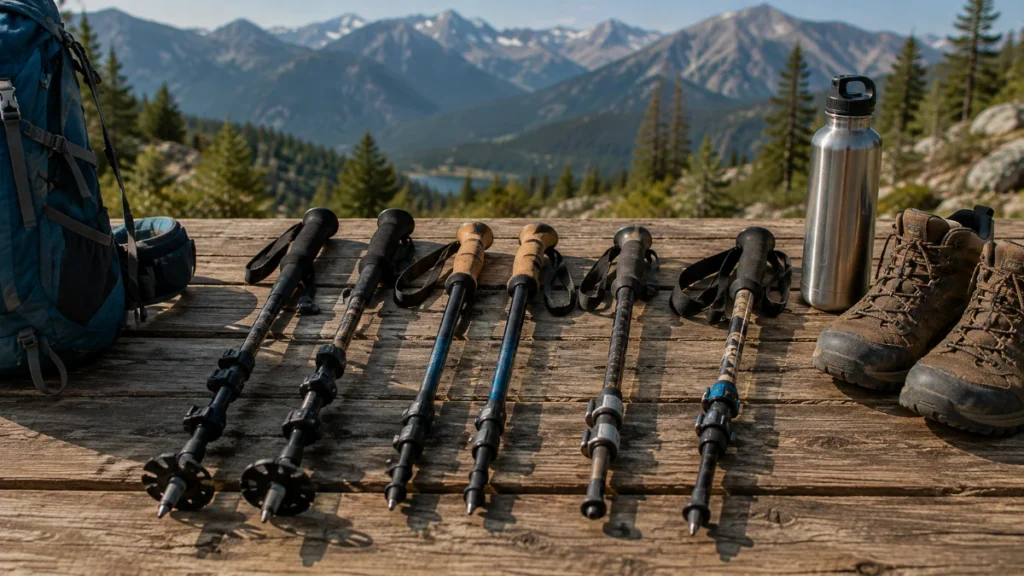
OutdoorCompass.net – Trekking poles aren’t essential for every hiker, but for the right trail — or the right knees — they make a real difference. This guide covers when poles are actually worth using, what to look for if you decide to buy a pair, and how a few commonly recommended beginner options compare.
Quick Picks
| Category | Product |
|---|---|
| All-Around | Black Diamond Trail Back |
| Comfort-Focused | LEKI Legacy Lite |
| Budget Carbon | Cascade Mountain Tech Carbon Fiber |
| Budget-Friendly | Cascade Mountain Tech Aluminum |
Comparing Beginner Hiking Poles
The specifications below are provided as a general comparison. Product details can vary by size, version, and seller, so verify current specifications, pricing, and availability before purchasing.
| Feature | Black Diamond Trail Back | LEKI Legacy Lite | Cascade Mountain Tech Carbon Fiber | Cascade Mountain Tech Aluminum |
|---|---|---|---|---|
| Best suited for | All-Around | Comfort-Focused | Budget Carbon | Budget-Friendly |
| Material | Aluminum shaft, EVA foam handle | Aluminum | Carbon fiber shaft, cork/EVA handle | Aluminum shaft, cork/EVA handle |
| Length | 51 in. extended, folds to ~50 cm | Adjustable 100–135 cm | 54 in. extended, folds to 26 in. | 54 in. extended, folds to 26 in. |
| Weight | 1.23 lb | 8.9 oz | 8 oz | 10.1 oz |
| Adjustment | FlickLock adjustable | Collapsible, adjustable | Quick-lock adjustable | Quick-lock adjustable |
| Included | — | — | 2 poles, mud baskets, rubber tips, snow baskets, clip, carry case | 2 poles, mud baskets, rubber tips, snow baskets, clip, carry case |
| Price | $99.95 | $109.95 | $109.95 | $29.99 |
Note: Product specifications can vary by model, size, or version. Verify the current manufacturer specifications and whether the listed weight refers to one pole or the pair before purchasing.
How to read this table for your situation:
- If you want a well-rounded, reliable pair without needing to weigh many trade-offs, the Black Diamond Trail Back is the overall pick here, with a straightforward FlickLock adjustment and solid review volume relative to its price tier.
- If comfort and fit adjustability matter most to you — for example, if you’re between typical height ranges — the LEKI Legacy Lite‘s wide 100–135 cm adjustment range and strong review rating make it worth a closer look.
- If you want carbon fiber’s lighter weight without paying premium carbon fiber pricing, the Cascade Mountain Tech Carbon Fiber pair is positioned as the budget carbon option, and its very high review count is worth noting.
- If you want the most affordable reliable starting point and don’t need carbon fiber’s weight savings, the Cascade Mountain Tech Aluminum pair covers the basics at a lower price point.
Verify the current price, availability, and seller information before purchasing.
Key Decision Factors
- Whether trekking poles actually benefit your typical hiking style
- Adjustable vs. fixed-length design
- Material (aluminum vs. carbon fiber) and the weight/durability/price trade-off
- Grip material and wrist strap comfort
- Correct sizing for your height
Do You Actually Need Hiking Poles?
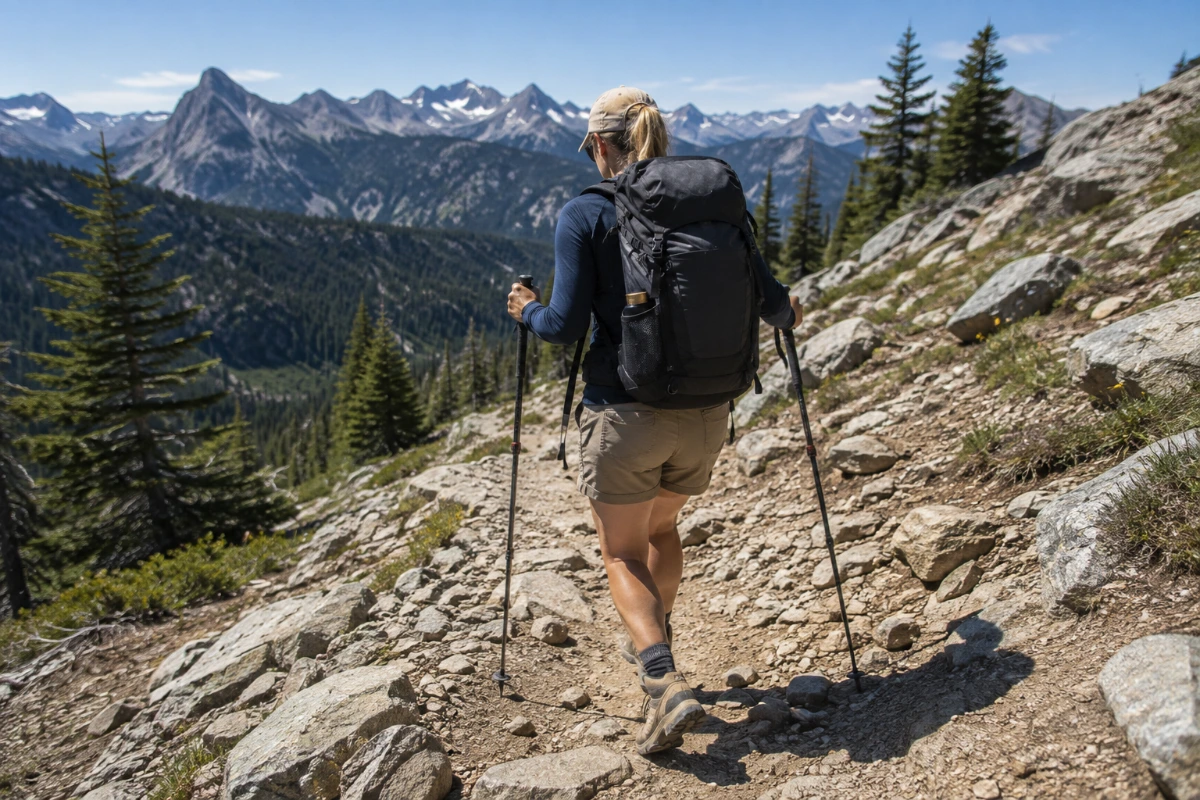
Trekking poles aren’t a universal requirement for beginners, and it’s worth being honest about that before spending money on a pair.
Poles tend to help most when:
- You’re hiking trails with significant downhill sections, since poles reduce impact on your knees on descents.
- You have pre-existing knee or joint sensitivity.
- You’re carrying a loaded backpack, where poles help with balance and reduce strain on your legs.
- You’re hiking on uneven, loose, or slippery terrain, where extra points of contact improve stability.
Poles matter less for short, flat, well-maintained trails, where the extra gear may not add much beyond what your own balance already provides. If your typical hikes are short and relatively flat, it’s reasonable to skip poles for now and revisit the decision as you take on more demanding trails.
Fixed-Length vs. Adjustable vs. Collapsible
- Fixed-length poles are simpler and often slightly lighter, but can’t be adjusted for different terrain (shorter for uphill, longer for downhill) or shared between hikers of different heights.
- Adjustable poles (typically via a lock mechanism like FlickLock or a twist-lock) let you fine-tune length for climbing, descending, or hiker height. For many beginners, adjustable poles offer a useful balance of flexibility and simplicity.
- Collapsible (folding) poles fold into shorter segments for compact storage, which is useful if pack space is limited or you don’t always plan to bring poles.
For most beginners, an adjustable pole offers the most flexibility without a significant downside.
Material: Aluminum vs. Carbon Fiber
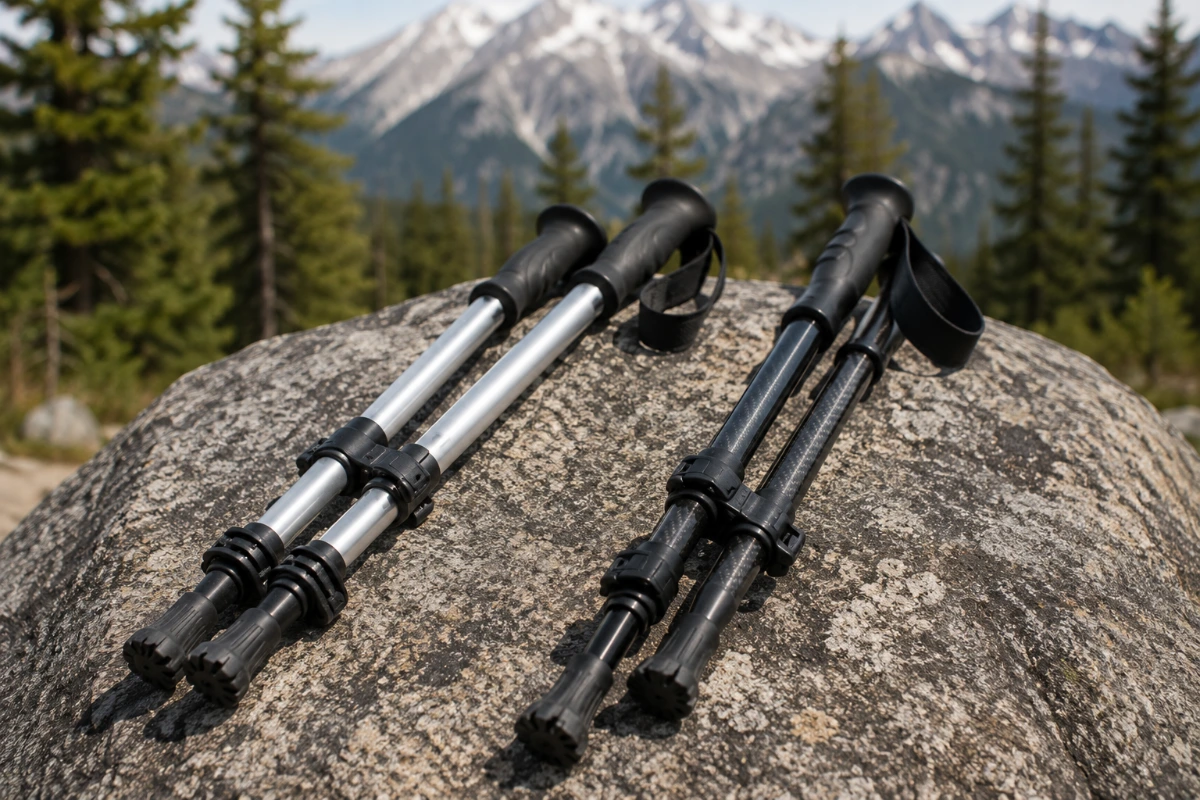
- Aluminum poles are generally affordable and can bend under significant force rather than breaking outright, which can be an advantage for some types of rough use.
- Carbon fiber poles are generally lighter and can be attractive for hikers who prioritize reducing weight. However, carbon fiber can be less forgiving under certain sharp impacts.
Neither material is objectively better — the choice depends on whether you prioritize lower weight or greater tolerance for rough use.
Grip and Wrist Strap Considerations
Grip material affects comfort over a long hike, particularly in different weather:
- Cork grips mold to your hand shape over time and tend to manage sweat well, which some hikers prefer for warm-weather comfort.
- EVA foam grips are lightweight and cushioned, offering good shock absorption, and are common on beginner-oriented poles.
Wrist straps matter too — a properly adjusted strap lets you rely on your wrist rather than gripping tightly with your hand for extended periods, reducing hand fatigue. It’s worth adjusting the strap so your hand sits comfortably through the loop before heading out, rather than using the default factory setting.
How to Size Hiking Poles Correctly
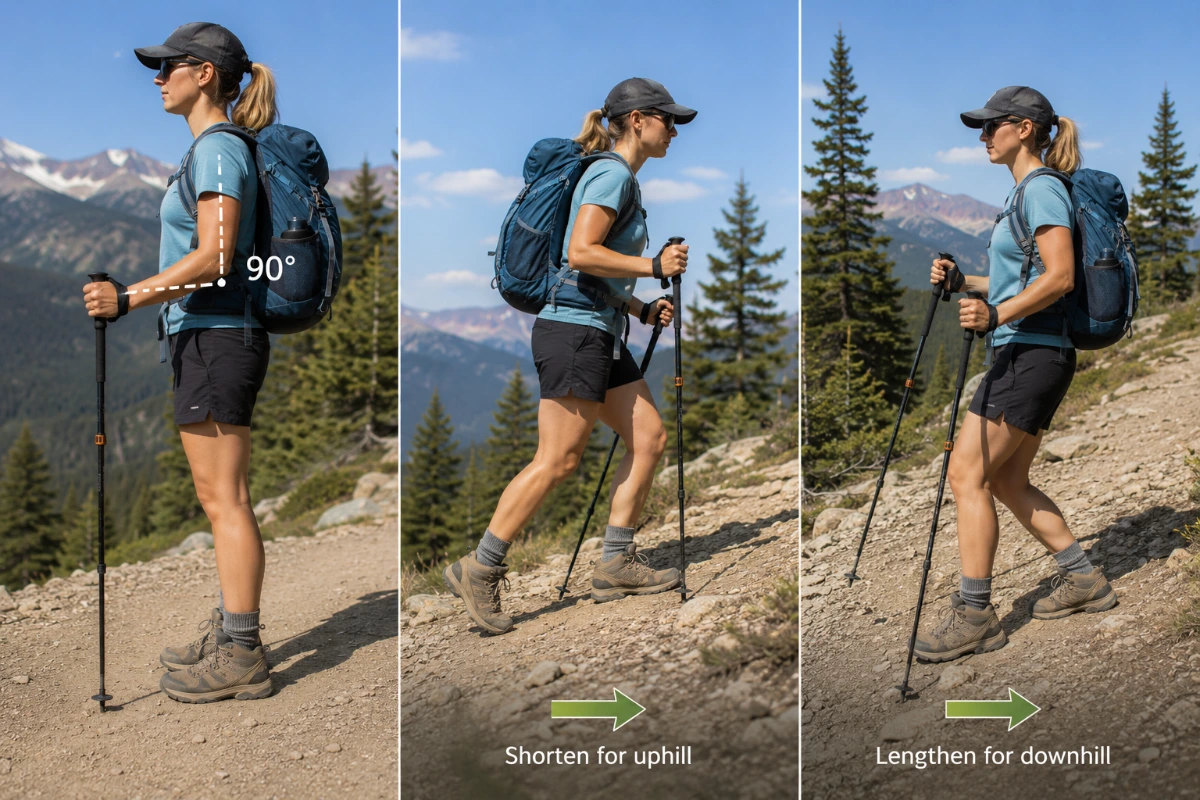
For adjustable poles, a reasonable starting point is setting pole length so your elbow forms roughly a 90-degree angle when the tip touches the ground and you’re standing upright holding the grip. From there:
- Shorten poles slightly for uphill sections.
- Lengthen poles slightly for downhill sections.
This isn’t a fixed rule — some hikers prefer poles a bit shorter or longer based on personal comfort and hiking style, but the 90-degree starting point is a useful starting point for most beginners.
Frequently Asked Questions
Do beginners really need trekking poles?
Not universally. Trekking poles are most useful on hikes with significant descents, uneven terrain, a loaded pack, or when additional support is helpful. For short, flat, well-maintained trails, they are optional rather than essential.
Is carbon fiber worth the extra cost over aluminum?
It depends on your priorities. Carbon fiber can reduce weight, which may matter more on longer hikes, while aluminum tends to offer greater durability under sharp impacts and is often more affordable. The choice is mainly a trade-off between weight, durability, and price.
How do I know what length to set my poles to?
A good starting point is to aim for roughly a 90-degree elbow angle when the pole tip touches the ground and you are standing upright. From that baseline, adjust the poles shorter for climbs and longer for descents.
Are trekking poles good for downhill hiking?
Yes. Trekking poles can be particularly useful on downhill sections because they provide additional points of contact and can help with balance. They may also make descents feel more controlled, especially on uneven or loose terrain.
Should I choose aluminum or carbon fiber hiking poles?
Aluminum is generally a practical choice if durability and affordability are priorities. Carbon fiber can be attractive if reducing weight is more important. Consider your terrain, hiking distance, and budget rather than assuming one material is universally better.
Choose Based on Your Trail, Not Just the Gear List
Trekking poles are genuinely useful for certain hiking conditions and unnecessary for others — the honest first question is whether your typical trails would actually benefit from them. If poles make sense for your typical trails, prioritize a comfortable grip, an appropriate length, and an adjustment system that suits how you hike.
OutdoorCompass
Explore More. Pack Smarter.